The City of London seems to be built on coffee shops. Every street, alley way, has at least one. There are certain chains that even locate their shops around the corner form each other, almost in competition with themselves. Obviously there is capacity for the multitude of coffee shops, but it amazes me how so many can be making enough money to keep afloat. People like myself frequent them; the self-employed, the freelancers, going into the City to meet people, network, and get work. We use coffee shops all the time. They are the mobile office, the meeting room and information hub (if the Wi-Fi is good). There are several I use, depending upon who I meet and what time of year it is. My favourite to meet people is in Leadenhall Market. The coffee and surroundings are perfect, but I wouldn’t go there during a school holiday, for fear of being swamped by floods of tourists searching for the Leaky Cauldron.
This way of using coffee shops for the “office-less”, is not new. In the 17th and 18th centuries, coffee shops, or coffee houses, in London were business hubs. Offices as we might think of them didn’t exist. What I am thinking of are the corporate premises, whole floors or buildings occupied by one company, with branding, where we go to spend our entire day. There were some, for example Samuel Pepys often talks about going to the office, but his work, in the Admiralty, was more governmental than commercial and free market. There were of course, shops, workshops and warehouse that were rooted to a particular building.
For the fluid free market of 17th/18th century commerce, a physical marketplace was needed. It was social activity, done face to face and with a handshake. In fact, deals could even be achieved on the street, although that wasn’t conducive to a confidential and comfortable work environment. Coffee houses could provide that. They were away from the hustle and bustle of the City, the cold and rain. They were also places where you would be able to find people and importantly, know that you could be found.
Particular coffee houses attracted certain trades. For example, Edward Lloyd’s Coffee House was famous for the place to go to find maritime insurers. Jonathan’s was where the stockjobbers would congregate. Stockjobbers traded in the markets, acting as agents for other people. In the later 18th century, they broke free from Jonathan’s Coffee House and set up their own premises, the Stock Exchange. The Jerusalem was a shipping exchange and owned by the East India Company. Traders dealing with North America, were found in the coffee houses adjacent to the Royal Exchange, such as the Carolina, Virginia, Pennsylvania and New York Coffee Houses. Tea merchants patronised Garraway’s. Garraway’s was the first coffee shop to sell tea, a reflection of its customer base. Causy’s Coffee House is where the Sun Fire Office was established and initially run from. It is now the Royal Sun Alliance. Similarly, the Hand in Hand (now within Aviva) was first established and run from Old Tom Slaughter’s Coffee House.
There were many coffee houses across the City of London and Westminster, and they catered for wide range of interest, not just financial investments and international trade.
Childs Coffee House was located near the College of Physicians in Warwick Lane in 1698 and from 1702 in St. Paul’s Churchyard. It was frequented by the fellows of the Royal Society, surgeons, doctors and the clergy of St. Paul’s Cathedral.
Guildhall Coffee House in Basinghall Street was where literary men would be found, with many book auctions being conducted there. Around the corner was The Chapter on Paternoster Row, which attracted booksellers. This area, north of St Paul’s was the place for printing and bookselling, and the location of Stationer’s Hall, which controlled publishing. Actors would go to Wright’s in Covent Garden, Welshmen to Daniel’s in Fleet Street and Frenchmen in Gile’s in St Martin’s Lane.
Coffee Houses were used for lectures, debates, buying and selling, auctions, gambling, as masonic lodges, plotting revolution and pamphlet circulation. The most important reason for going to a coffee house must have been being around people like oneself, for aspiration and gossip.
The Coffee House
Gentlemen would spend many hours in a coffee house, or several in the course of a day. It did not cost that much. There was an entrance fee of 1 penny, and you would pay extra for coffee and tobacco. A gentleman could spend as much time as he wanted in the comfort and warmth of a building.
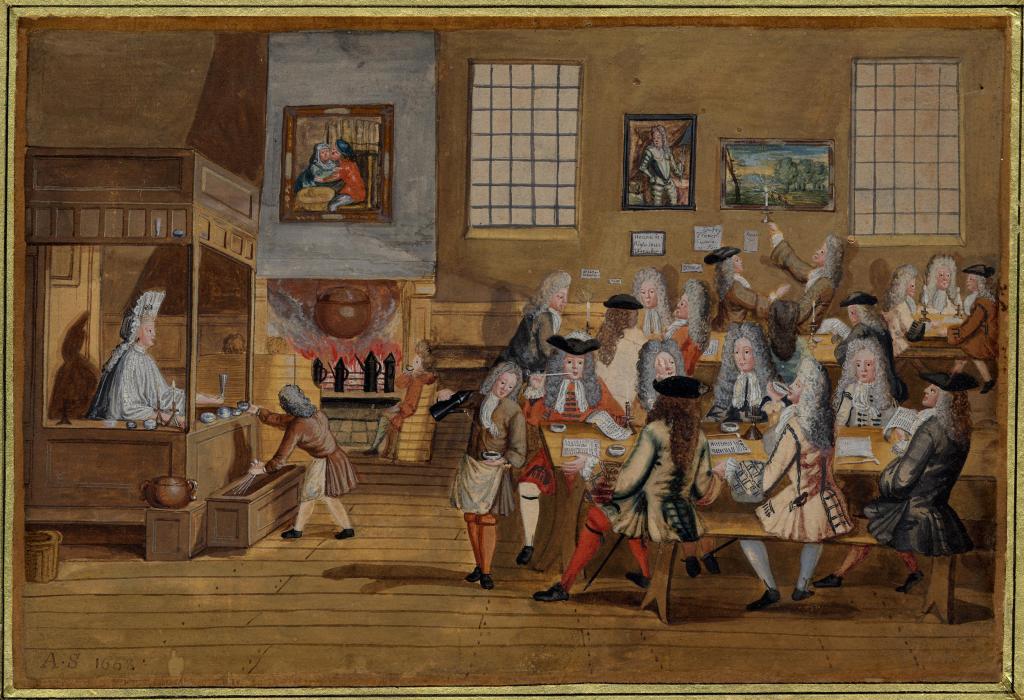
The layout was communal with central long tables and seating either side. It made it easy for networking and getting to know people. At one end of the room was the kiosk where the proprietor sat taking payments. The images of late 17th century/early 18th century coffee houses, show women in these kiosks and presumably were the proprietors, or managers. Other than that, the coffee houses were the domain for men.
Coffee processing all happened onsite, the roasting, grinding and boiling. A roaring fire was on one side of the room, which was for the roasting and boiling the coffee. Looking at the image from the British Library, in front of the fire a number of coffee pots were placed keeping the coffee warm. Young men and boys served the coffee poured it into small bowls at the tables. Other consumables were sold, such as tobacco in pipes, and certain coffee houses would also sell chocolate and tea, although coffee was the main drink consumed.
I imagine the roasting and grinding of the beans, the cooking of the coffee, and the smoking of the tobacco, must have made the coffee shop an aromatic place to be.
Information and intelleligence
To make their coffee houses compelling places to be, the owners would provide up to date information for their customers. Pamphlets, broadsheets, and the London Gazette, would be available for customers. Up to date news from around the world was also gleaned from newly arrived boats.
The Jerusalem displayed ships lists within the coffee shop. These lists showed the ships sailing to and from India and China showing the name of the ship, the commander, when departed, when arrived, the ports the ship was due to visit, the tonnage, the crew, the ship’s husband (ie who looks after the upkeep and repair) and cannon. All this was vital information for any investor, merchant or insurer to measure the risk of a voyage. Find out more here…
Conversely, they were also great places to distribute your religious, political or business pamphlets. Along with debates and discussions some coffee houses became centres of such political/religious life.
The dark side to the Coffee Houses
When we start thinking about the business and trade carried out, the coffee houses become a darker place. The Jerusalem, trading in all things maritime, with ships list going to and from China, with a stop off in the Bangladesh area. On the return leg, this was the tea trade, but on the way out, it was the opium trade controlled by the East India Company, who owned the Jerusalem. In Bangladesh, on land owned by the East India Company, the farming of food was sacrificed for the farming of opium. Famines struck, communities were devastated, and millions dies. The opium trade was an attempt to create a trade with China, using an addiction. It resulted in the Opium Wars, Hong Kong and issues that feed through to today.
Lloyd’s Coffee House, considered to be one of the famous coffee houses, dealt with maritime trade and particularly insurance. This trade fulled a demand dor sugar, cotton and coffee, under pinned the trans-Atlantic slave trade, plantation ownership, enslaved people, and again, issues that feed through to today.
The coffee shops, the trade and places to make money provided a basis for colonialism and the beginnings of empire.
Robert Hooke’s coffee houses.
Going back to the early days of the coffee houses, I took a look at Robert Hooke’s diary, where he recorded his daily business activities 1672, to 1680. He was a busy man and along with being a scientist and architect, he was also a fire judge that settled property disputes in the City of London after the 1666 Great Fire. The role came with much influence in the City and he was in demand.
Going through his diary, I am surprised to see the amount of time he spent in coffee houses, not just the number of hours per day, but the number he would visit. He didn’t just go to a coffee house sit there, hang out, enjoying the coffee and gossip. He would meet people, pay them, make plans, decisions, and then off to another coffee house to meet another group of people concerning another project. His favourite coffee house was Garraway’s, which was in Exchange Alley. Incidentally, Hooke’s favourite drink though was neither tea, nor coffee. It was chocolate. Hooke didn’t have a sweet tooth as such, but was obsessed with his health. He believed drinking chocolate was good for the health, which of course, it is.
Here’s a week of his life in March 1676:
Monday 6th March – “Stayd at Mans coffee house.”
Wednesday 8th March – “Post Prandium at Littleberrys… at Garraways Oliver faild &c”
Thursday 9 March, 1675, “… At Childs coffee house with Warder and Dep. Smith. To Sire Chr: Wrens. Agreed with Cartwright for Bow Tower for “£2550… With Barrington about Sir R Viners at Cardinalls cap, at the Crown and coffee house.”
Friday 10th March – “At John Coffee house, Barrington and Browning. At Garaways, Agreed Riders fee to the Rent. D.H. (dined at home) At Bridewell about Turret. With Chase at the Globe 6d… To Garaways. Gave module of a house to Mr Marchant.”
Saturday 11 March – “at Garraways and met Mr Logan at Mans. He told me of his cuts of the Bible for 12sh or 14sh.”
Sunday 12 March – “Garraways, Monr. Ruell here. Shewd him turret and double balanced watch.”
Finally, an example of what sounds like the slightly bizarre, but it was probably all in a day’s work. On 13th January 1676, he “Saw Engine at Garaways with the one eyed paynter”, and on 9th January, “At Garaways. Discoursed with Harry about my undertaking to fly.”
London
London has a strange continuity. I often find the same activity goes on in the same place, over 100s, sometimes 1000s of years. It adapts and morphs, and the buildings change, but areas somehow maintain a similar use. The City had coffee shops littered across it, with people going from place to place looking to find and meet co-workers, clients and friends. I find myself going from coffee shop to coffee shop (occasionally Lloyd’s café) to for the same reasons, just as Hooke and many, many others did in the same “stomping ground”, the same streets and alleyways. Although I don’t have any undertakings to fly.
References
Clayton, Anton, (2003), London’s Coffee Houses. London: Historical Publications.
Robinson, H and Adams, W, (1935), The Diary of Robert Hook. London: Taylor and Francis.
The Jerusalem Coffee House – another piece on this blog. The Coffee House Ships List – An Historier’s Miscellany (anhistoriersmiscellany.com)


Fascinating! And I’m intrigued by Hooke’s ‘undertaking to fly’ – could this be connected with his work on flies in the Micrographia? Bit early for balloons…
LikeLike