Chocolate took off as a popular and luxurious drink in 17th century Europe. It has all the trappings of an expensive commodity, using expensive imported ingredients and difficult to make. It was first encountered by Europeans in the early 16th century, when Christopher Columbus came across the beans on his fourth voyage to the Americas. Later, the conquistador, Hernán Cortés, possibly encountered it as a drink when he visited the court of Montezuma, in modern-day Mexico. The European craze for chocolate began 100 later, in the early 1600s.
The first chocolate house in London, was in 1657. Making chocolate was a specialised job and not something readily done at home. Typically, one would visit a chocolate house to enjoy the drink and socialise. Although the first chocolate house was in Bishopsgate, most centred around St James’s in Westminster. The City coffee houses did sell chocolate as well as coffee, but the quality was not as good, as it was a difficult drink to make, and there wasn’t much demand for chocolate in the City coffee houses. They were the places to go for business, and caffeine-induced coffee was the drink associated with being sharp-witted and making profitable deals.
Chocolate was a drink for leisure. It was expensive, luxurious, aspirational and only drunk by those who could afford it.
It was also seen as nourishment and medicinal. Robert Hooke, 17th century sci
icines, and would make a note of when he drank chocolate:
“To Sir Chr. Wrens. Walked with him. Choclatt at Mans.”
Friday 25th February 1676. Mans was a coffee house on Lincoln’s Inn Gate in Chancery Lane.
Samuel Pepys was also a chocolate drinker and would often have it at breakfast, or as a morning beverage, as often it was taken.
Making chocolate was a lengthy process that required specialised skills. First of all, the cocoa beans would need to be roasted, and the nut would need to be taken out of the shell. These nuts would then be ground to a paste. The cocoa nut contains oil which when ground, made this paste-like substance. The more it was ground, the better the quality of the chocolate. The paste was made into a ‘cake’, which was a block of cocoa that was easy to store, transport and would mature with age.
In the 17th century the chocolate drink was the main consumable from the paste. When required, the cake would be broken up and mixed with water. It was a case of dissolving the cocoa, not straining it and discarding the leaves or grounds as with coffee or tea. Due to the oil, the cocoa didn’t easily dissolve, so to make the drink it had to be boiled and constantly whisked. Otherwise, there would be lumps of ‘fatty’ cocoa within the drink.
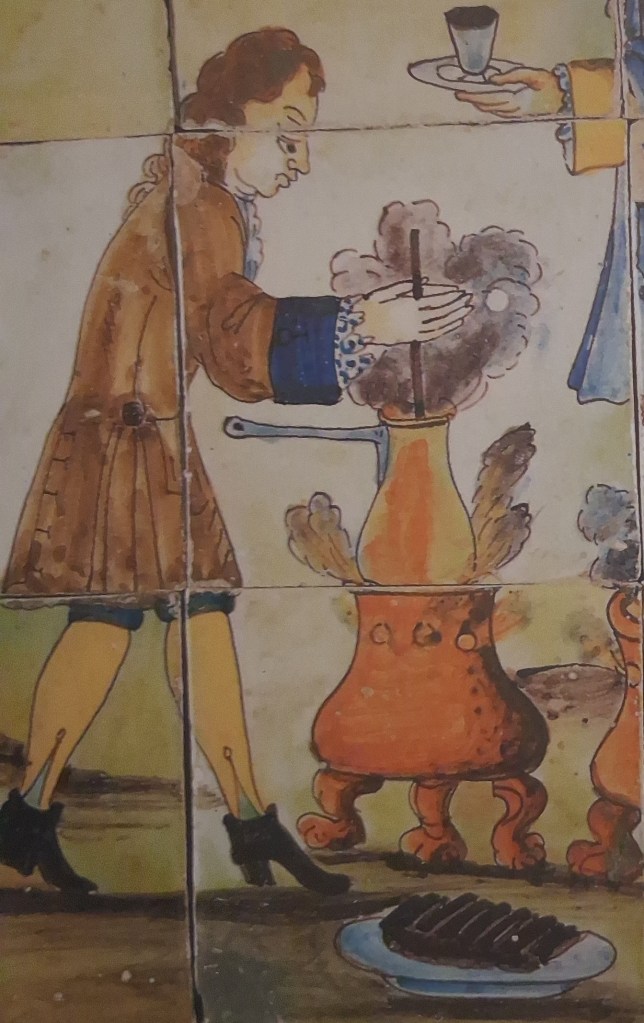
Pure chocolate, has a very bitter taste, and was not to the liking of 17th century Europe. A lot of sugar was used to sweeten the drink. Other flavourings were also used, including vanilla, cinnamon, aniseed, pepper and famously chilli. Milk, eggs or wine could also be added.
Going back to Robert Hooke, he did make chocolate at home, but not always with success:
“Grace Made chocolate but heat it too hot without water.” Friday 11th February 1676.
Grace was Hooke’s housekeeper and niece. William III was a lover of chocolate. He brought his taste for it from Holland when he ascended the throne with Mary during the Glorious Revolution in 1689. In such elite households, it was a popular breakfast drink, But William III drank it throughout the day. He employed is own chocolatier, by the name of Solomon de le Faya.
All the ingredients for chocolate were imported from around the world and thus expensive. The main ingredients, the cacao and the sugar, came from plantations in the Caribbean and South America. Like many of the aspirational consumables of the time, the production was underpinned by the slave trade and enslaved people working on the plantations.
In the early 19th century, in 1828, a process was introduced for removing cacao oils and grinding the nibs to make powder. This powder was mass-produced, and as a result, chocolate became an affordable everyday treat. Interestingly, although chocolate has become affordable and remains so today, it is still perceived as luxurious and something reserved for special occasions, or to cheer yourself up. There is still a view of it being medicinal, even if good for the soul and daily well-being. There are high-end and low-end chocolate products, but when it comes to marketing, the angle is always quality and luxury.
Make some chocolate
The 21st century hot chocolate we drink today is very different to the chocolate of the 17th century. Those who were lucky enough to drink within the chocolate shops found in St James’s would not recognise our hot chocolate.
The preparation is quite alchemical – this period was a time of scientific philosophy. I am sure it would have appealed to gentlemen of the time. If you want to have a go at making something similar to the 17th century style, first choose your raw material.
Cocoa or nibs
If you choose to buy raw cacao beans and roast them, good luck; however, I recommend sourcing some cocoa nibs as close to 100% as possible. Try a fairtrade and organic variety. I bought some in a well-recognised high street health food shop. But there are many to choose from. Cocoa powder is straightforward as it is already ground, and you simply add it to hot water, boil and stir. If you choose nibs, then you will have to grind them using a pestle and mortar. Nibs are the broken, roasted cocoa beans, and they won’t simply dissolve in boiling water. They grind into a dry paste. Make sure all the nibs are ground into this state; otherwise, they will not dissolve. I didn’t grind mine enough. I thought they were, but no, and the result was neither attractive nor tasty. I went back to using cocoa powder.
Making the Chocolate
You will need 2 tablespoons of cocoa with half a cup of water. Add the heated water to the cocoa in a small pan, adding the water a little at a time. Keep it over the heat, adding the water and mixing it. Obviously, cocoa powder will dissolve quickly than the paste. As it heats, the mixture will become thicker. Add the sugar and your chosen flavourings as you see fit. Have fun and experiment.
Serving
Serve the chocolate in a small bowl with no handles. This is how it was drunk. If you wish to experience it in greater depth, then wear a frock coat, full-length waistcoat, stockings, and a full-bottomed peri-wig, or a fontange, silk gown and stomachers, pinned onto a pair of stays. Don’t spill any on your frock coat; I don’t want to go into 17th century dry-cleaning.
Referemces
Coe, Sophie and Coe, Michael, 1996, The True History of Chocolate. London


 An Historier's Miscellany