Working in heritage invariable means at some point be involved with war in some way or other. There is so much to the world and history than war, but at the same time, war has impacted of people’s lives, communities and nations. It has shaped our thinking towards nations, patriotism, pacifism and exposed us to terrors that are carried out during war.
I hate war and I could go on about how we, as a society, don’t look at it enough. I feel that we are separated from it so much so that we use phrases such as “Keep Calm and Carry On” in a very different context to its original intention. A nostalgia around it has grown up, where people have had Blitz parties and some sort of late Second World War “vibe” as part of weddings with US Jeeps and Jitterbugging is part of the celebrations.
The Second World War has been the one I’ve worked with the most. Not by choice, or that I was a fanatic of the War, or armies within it. Usually I’ve worked with it because it was a job, or part of a job. Every tenth anniversary there is a surge of events and exhibitions unlocking lesser known stories. I’ve worked with many veterans, who were in the forces, people who worked at home, and even were children at the time. People who were on the “Home Front” were very interesting. I always felt they did not tell 100% of the story, leaving out details, perhaps the horror of what faced them in their lives. One time a group of ladies I was working with “shushed” one of the group who had began recalling a story. I hadn’t quite got what she was about to say, and I felt it rude to explore any further.
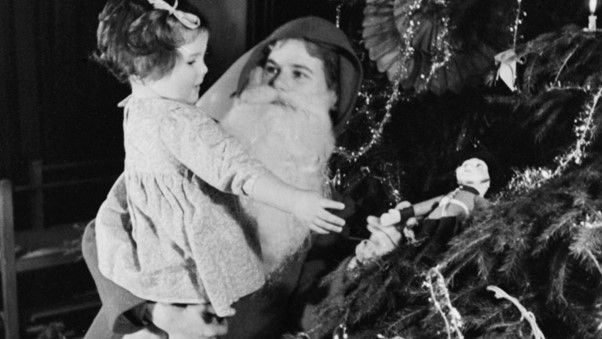
Christmas was always an interesting subject with mixed emotions. I spoke to a few people about Christmas, when working with elder groups in December. When asked, most who lived through the Second World War say that Christmas never really happened. It wasn’t a time of celebration and over-indulgence, and for some it could be a very hard time. Many people weren’t with their families, relatives had died, men were abroad, women in the land army and children had been evacuated out of cities. Food, clothes and even presents were in short supply and rationed. “Strange as it may seem, I don’t have strong memories of Christmas during the war”, said Ruth Wainwright who was four years old when war broke out. There was no sense of Christmas as we have now.
As with most of the War, times were very hard with no real let up. Today we have this sense of people pulling together and making the most of what they had. Some people were determined to have a good time regardless of the shortages and effort was made for the children, especially the evacuees who must have felt very lonely. Toys, gifts and decorations were made out of all sorts of scraps and odds and ends.
Fran, who was a child in Holborn at the time, remembers spending afternoons making paper chains. “There was no self-adhesive paper, we had separate paper and glue.” Trees were rare, unless you lived in or near the countryside where you could also collect holly from fields and woods. Alternatively, people wrapped tinsel around wire hangers, used eggshells for bulbs and knitted decorations.
Toys would be homemade, usually out of scraps. Knitting was an easy skill to learn. Scarves, hats and dolls were knitted from second hand wool having been unpicked from an old jumper or socks. All sorts of materials would be used, bits of cardboard, fabric and empty match boxes. “One year I had a dolls house complete with furniture. I was over the moon. Little did I know at the time, my father had spent hours making it, perhaps at work or in his shed,” Ruth explained
The traditional Christmas foods were scarcer than the normal rations. In December 1943 the government announced that only 1 family in 10 would get a goose or turkey. Christmas pudding and cake were easier to organize and plan ahead as dried fruit could be saved up from the months before. Authorities were conscious of moral and tried to make things easier. In 1944 the Ministry of Food announced treats for the Christmas period including 1/2 lb of margarine, extra meat or 6oz cheese for vegetarians and 1/2lb of sweets for holders of children’s ration books. This was towards the end of the War, the Allies were pushing through Europe, and the north Atlantic trade routes had been secured. Perhaps supplies were not so scarce.
Alcohol was not rationed, but in short supply. People tried all sorts of tactics to ensure they had enough drink, such as buying one night’s worth of beer when first entering the pub. Wine was not imported as it was not a necessity, but it was easy to make and people did, using what was around them, elderberry, blackberries, nettle or even beetroot wine.
With many families broken up, neighbours and friends celebrated together. Eddie Gardener said that “out of our family of 8, only 3 of us were together for Christmas in 1943. Our neighbour Mrs. Hetherington took our ration books, bought all the food and cooked us Christmas dinner.” Eddie’s wife Joyce remembers that after the food everyone would go into the front room and play board games such as Monopoly.
On the day itself, after the presents opened and the food eaten, the radio would go on at 3pm for the King’s speech. Ruth said, “Of course it went over my head as I was very young, but I do remember how serious my parents were, and I must have felt the importance of it all. I thought Christmas was wonderful and exciting. But I was so young I never knew any different. I guess it must have been quite hard work and perseverance for Mums to put on a “show”. For my parents, I think they were thankful that the end of another year was reached.”
From my own childhood, much of what they were saying resonated. The paperchains, the homemade wine, the homemade toys. My mother used to knit and outfits for my action men. That was only 30 years after the end of the Second World War. The War had such an impact on people, there was a hangover from it, and perhaps resources were low. Old habits die hard.

 An Historier's Miscellany